← Interactive guidePUBLIC RECORD / READING EDITIONOffline ZIP ↓

The Covenant, the Sword, and the Arm of the Lord / 1970s–2026

The promise. The siege.

How did a religious retreat become an armed white-supremacist group—and how did its confrontation with the FBI end without a firefight?

An independent documentary guide, researched and written with ChatGPT. It is not affiliated with the CSA, the FBI, or The AI Files. Document scans retain the original federal redactions.

Scope & method / Edition 1.1

A memorable name. A record that needs separating.

This file follows the community’s formation, its turn to Christian Identity and criminal violence, the April 1985 surrender, and the distinct trials that followed. It separates an appellate court’s findings, an investigative report’s assertions, and a former leader’s recollections.

Read the chapters for a narrative; use the record below to test it. Established means the specific proposition is documented. Interpretation marks an inference or a historical argument. Unknown means the record here cannot decide. An archive’s possession of a document does not endorse its contents.

Research cutoff: 25 October 2026. This is a curated history, not a complete membership census or a reconstruction of every local case. The 1985 siege is dated broadly where primary and contemporary accounts conflict. No claim is made that all residents committed the same crimes.

01 / The record

The story

The complete narrative, followed by the supporting record.

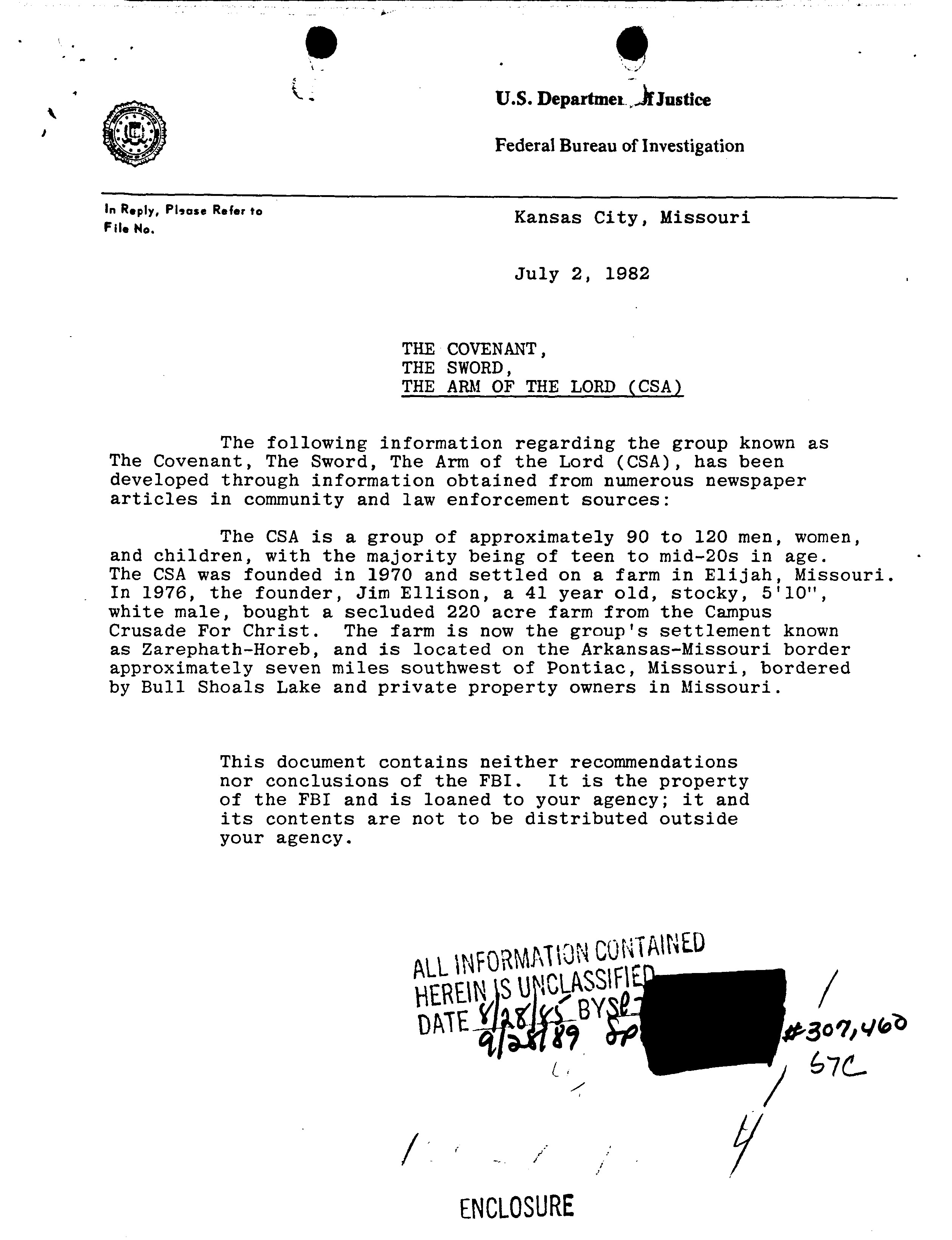
FBI summary of the CSA community, 2 July 1982
The FBI’s July 1982 community summary. Its estimate counts men, women, and children; it is not a count of armed fighters. Image credit ↗

Chapter 01 / Early 1970s–1978

A refuge becomes a fortress

Before there was a siege, there was a place to live. James Ellison’s community began as a religious refuge in the early 1970s and settled in northern Arkansas during the middle of that decade. Its compound lay near the Missouri border, in the country around Bull Shoals Lake. Families could understand the move as a retreat from a threatening outside world: shared work, shared worship, and preparation for hardship. The later name, the Covenant, the Sword, and the Arm of the Lord, compresses that promise of protection into a claim of divine authority.

The dates need care. A July 1982 FBI account says the community began in 1970; regional histories commonly say 1971. The later appellate opinion describes the Arkansas refuge as established in the mid-1970s. These statements need not identify the same institutional moment. In his 2020 interview, former leader Kerry Noble places his own arrival in 1977 and the public adoption of the CSA name in 1981. A single founding year would conceal the difference between an early religious community, a settled compound, and a publicly identified paramilitary organization.

The Eighth Circuit’s account identifies 1978 as a turn toward preparation for an expected government collapse and civil war. The retreat’s meaning was changing. Storing supplies could become a reason to anticipate enemies; protection of the community could justify an expanding military identity. That is an interpretation of the sequence, rather than a claim that rural life or religious expectation inherently produces violence. What matters here is what this particular leadership chose to teach, organize, and eventually do.

Even the size of the group can be distorted by hindsight. The July 1982 federal summary estimated ninety to 120 residents, explicitly including women and children. A later report described a shrinking population. Those figures were estimates assembled by investigators, not audited membership rolls. They cannot honestly be turned into an exact number of gunmen. The compound was a community containing different roles and levels of responsibility, even as its leadership developed a program that would place residents and outsiders in danger.
Sources: S01 · S02 · S07 · S10 · S11

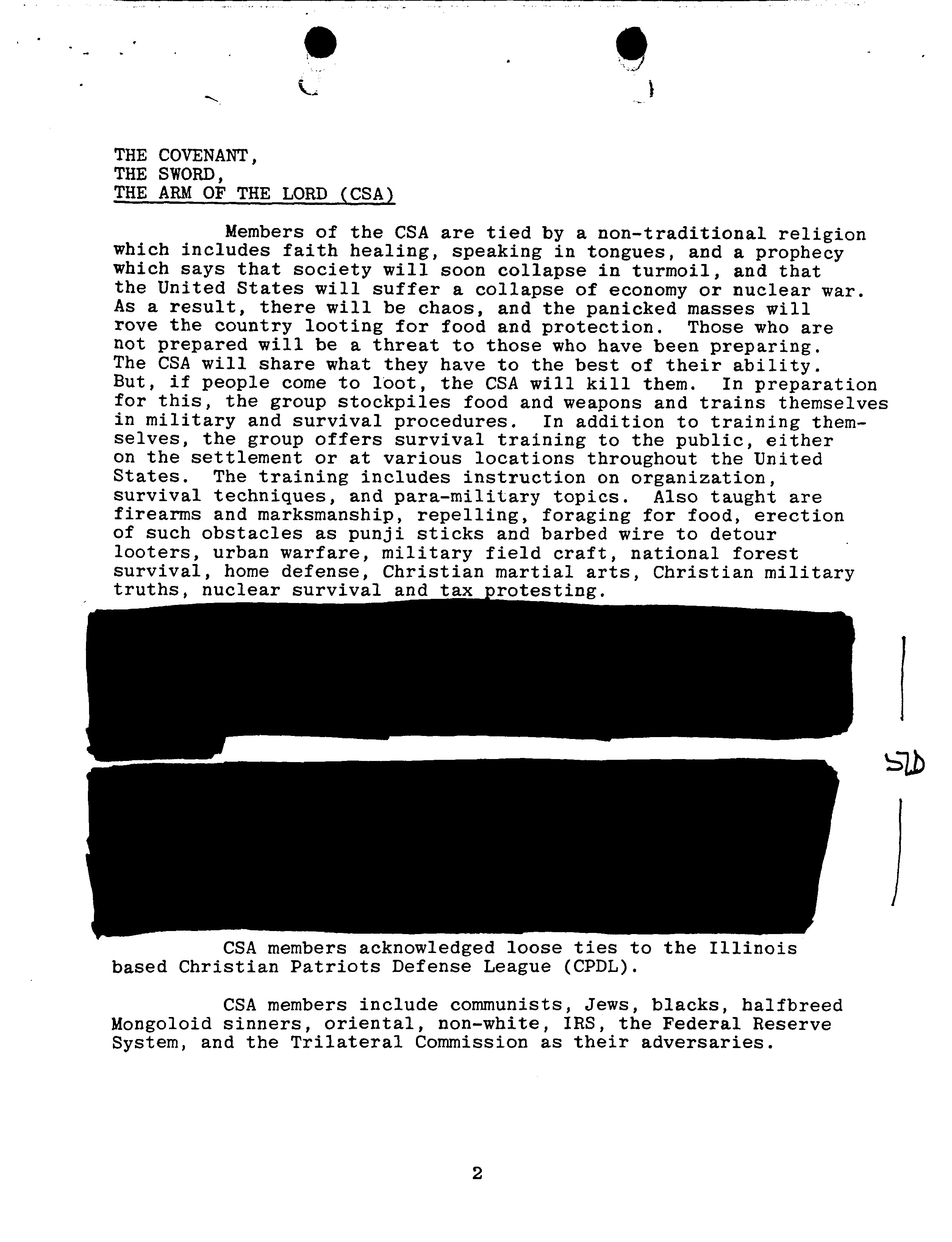
FBI account of CSA beliefs and training, July 1982
A continuation of the July 1982 FBI summary describes the group’s apocalyptic expectations and public training. This is an investigator’s description, not a reproduction of a CSA manual. Image credit ↗

Chapter 02 / 1978–1982

The theology drew a line around humanity

The CSA’s racial theology was specific. Christian Identity, as adopted by the group, portrayed white people as the true biblical chosen people and denied the standing of Jews and other racial groups. That ideology should not be treated as a synonym for Christianity, conservative religion, or survivalism in general. It supplied a racial account of who belonged inside the protected community and who could be cast as a hostile outsider. The FBI’s descriptions and the later court record place white supremacy at the center of the organization’s purpose.

Noble’s retrospective interview gives the shift a personal chronology. He describes a community initially organized around religious fellowship, the adoption of armed preparation after 1978, and the later incorporation of Christian Identity. His recollection is valuable because he helped teach and publicize the movement. It also needs the limits appropriate to a former leader explaining his own transformation. The interview cannot independently establish everyone’s motives, nor can his later rejection of racism undo the responsibility attached to the earlier activity.

The compound offered training and cultivated a paramilitary identity. Federal reports describe public survival instruction alongside the residents’ own preparation. The importance is social as well as physical: an organization could turn an anticipated catastrophe into routines, ranks, and a common explanation of the outside world. A threat did not have to arrive for members to rehearse their role in it. The combination of prophetic expectation and racial exclusion made preparation more than an ordinary household decision to keep emergency supplies.

The transition from preparation to aggression was not merely rhetorical. The criminal record examined later in this guide describes acts undertaken outside the property. That distinction prevents two opposite errors. One is to treat abhorrent belief alone as proof of every crime alleged against a believer. The other is to describe documented criminal activity as nothing more than unpopular religious opinion. The organization’s theology helps explain the pattern, but responsibility still has to be attached to particular people, evidence, and actions. The name may be memorable; the consequential question is what that worldview authorized.

Sources: S01 · S02 · S10 · S11

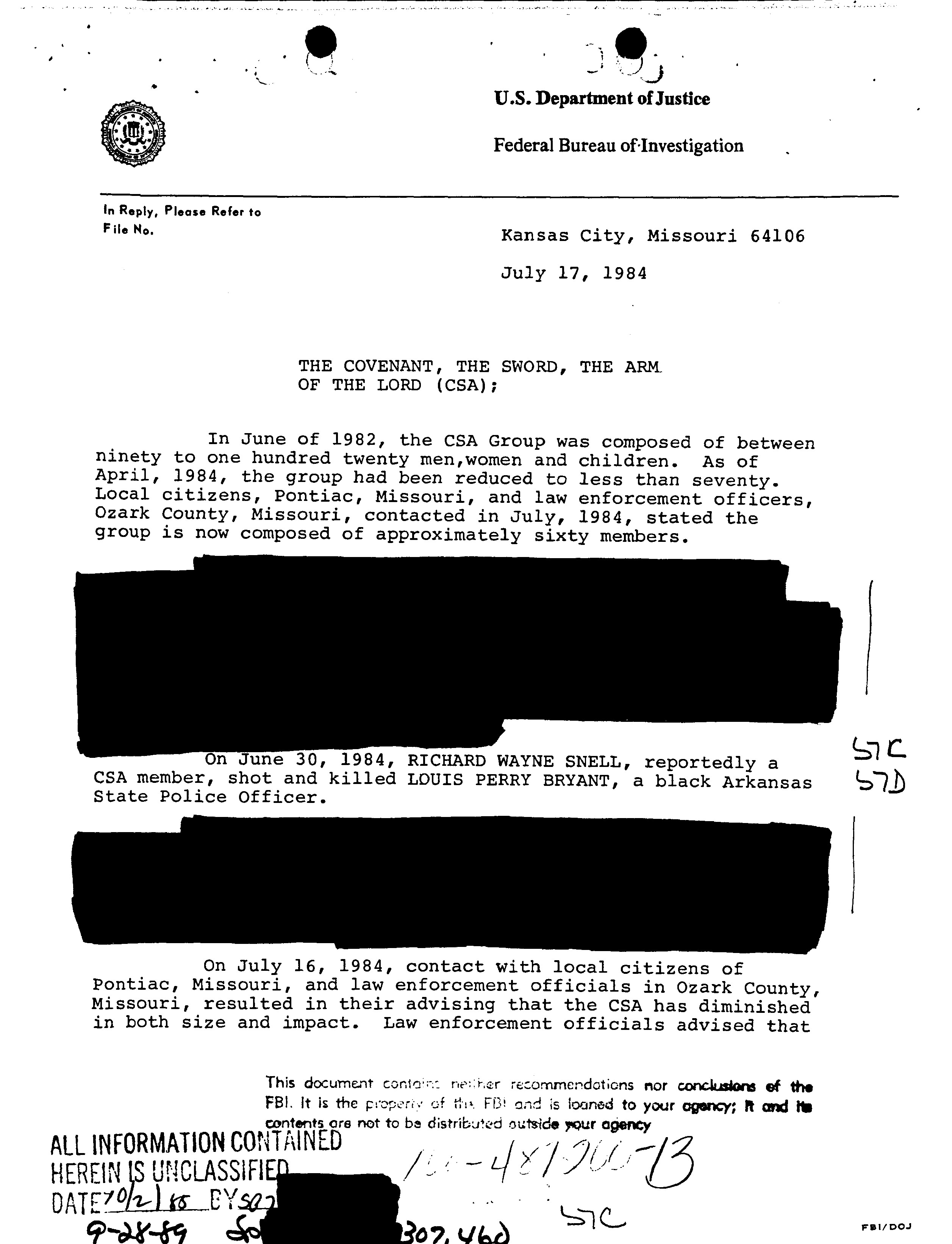
FBI update on membership and the Bryant killing, 17 July 1984
The FBI’s July 1984 update identifies Arkansas State Police officer Louis Perry Bryant. This specific record helps correct a later regional conflation. Image credit ↗

Chapter 03 / 1983–1984

The violence had names

William Stumpp was killed in his Texarkana pawnshop on November 3, 1983. Arkansas State Trooper Louis Perry Bryant was killed in June 1984. These deaths should remain visible in a history too easily dominated by the organization’s name, its compound, and its final confrontation. Richard Wayne Snell’s criminal cases supply a firmer basis for discussing responsibility than an undifferentiated list of crimes attributed to a movement. The people who died were not abstract examples of the danger of extremism; they were the victims of particular acts.

The Arkansas Supreme Court’s 1986 Stumpp opinion connects Snell’s activity with people and resources associated with the CSA. The majority recounts evidence involving associates, property, and the compound, and affirms the conviction. It also rejects the idea that a dispute over formal membership can dispose of demonstrated involvement. That is a narrower and more useful proposition than saying everyone who lived at the site was responsible for Snell’s crimes. The chain of evidence matters precisely because organizational labels can obscure individual acts.

The decision also contains a dissent. Justice John Purtle objected to what he regarded as a prejudicial trial atmosphere and the admission of material beyond the charged murder. Including that objection does not reverse the court’s judgment. It shows why the evidentiary question has to remain visible even in a case involving a profoundly unsympathetic defendant. An account of a conviction should identify what was decided, acknowledge a material dissent, and avoid converting the court’s reasoning into an unlimited license for guilt by association.

The broader federal record describes additional arson, weapons, and theft allegations, followed by specific prosecutions. Those matters should not all be given the same status. An investigator’s report may record a suspected link; a witness may recount conduct; a court may describe evidence sufficient for a warrant or affirm a conviction. Reading those categories separately does not minimize the violence. It makes the account more exact. It also protects the victims’ history from being displaced by a sweeping story that is easier to tell than to prove.

Sources: S01 · S02 · S03 · S07 · S09

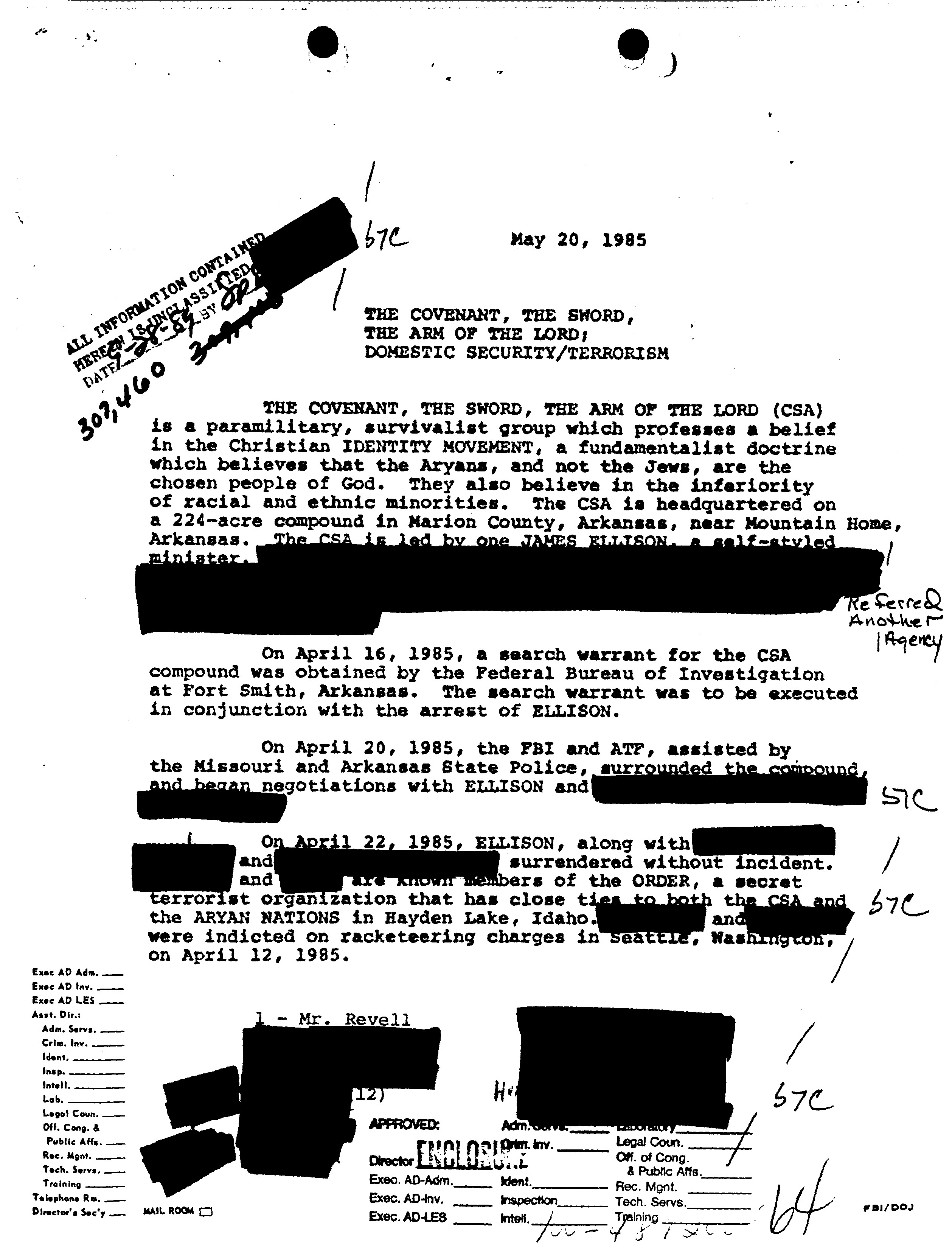
FBI memorandum on the surrender, 20 May 1985
The 20 May 1985 FBI memorandum dates the surround-and-negotiate operation to 20 April and surrender to 22 April. Other records give different dates or durations. Image credit ↗

Chapter 04 / April 1985

The confrontation ended in surrender

By April 1985, the federal investigation had produced warrants to search the property and arrest Ellison. FBI and ATF personnel joined state and other law-enforcement officers around a compound whose occupants had been preparing for conflict with the government. The familiar shorthand that the FBI “took down” the group captures the result, but misses the defining feature of the operation. The authorities obtained a surrender through containment and negotiation. The final encounter did not become the firefight that the setting made possible.

The exact sequence is less tidy than a single anniversary caption suggests. A May 20 FBI memorandum dates the surrounding of the compound to April 20 and Ellison’s surrender to April 22. An October accomplishment form in the same release lists an April 21 arrest, while contemporary press and later recollections count the duration differently. The appellate opinion summarizes a three-day resistance before surrender without resolving every calendar discrepancy. The guide therefore identifies April 1985 as the settled event and attributes more precise dates to the record that supplies them.

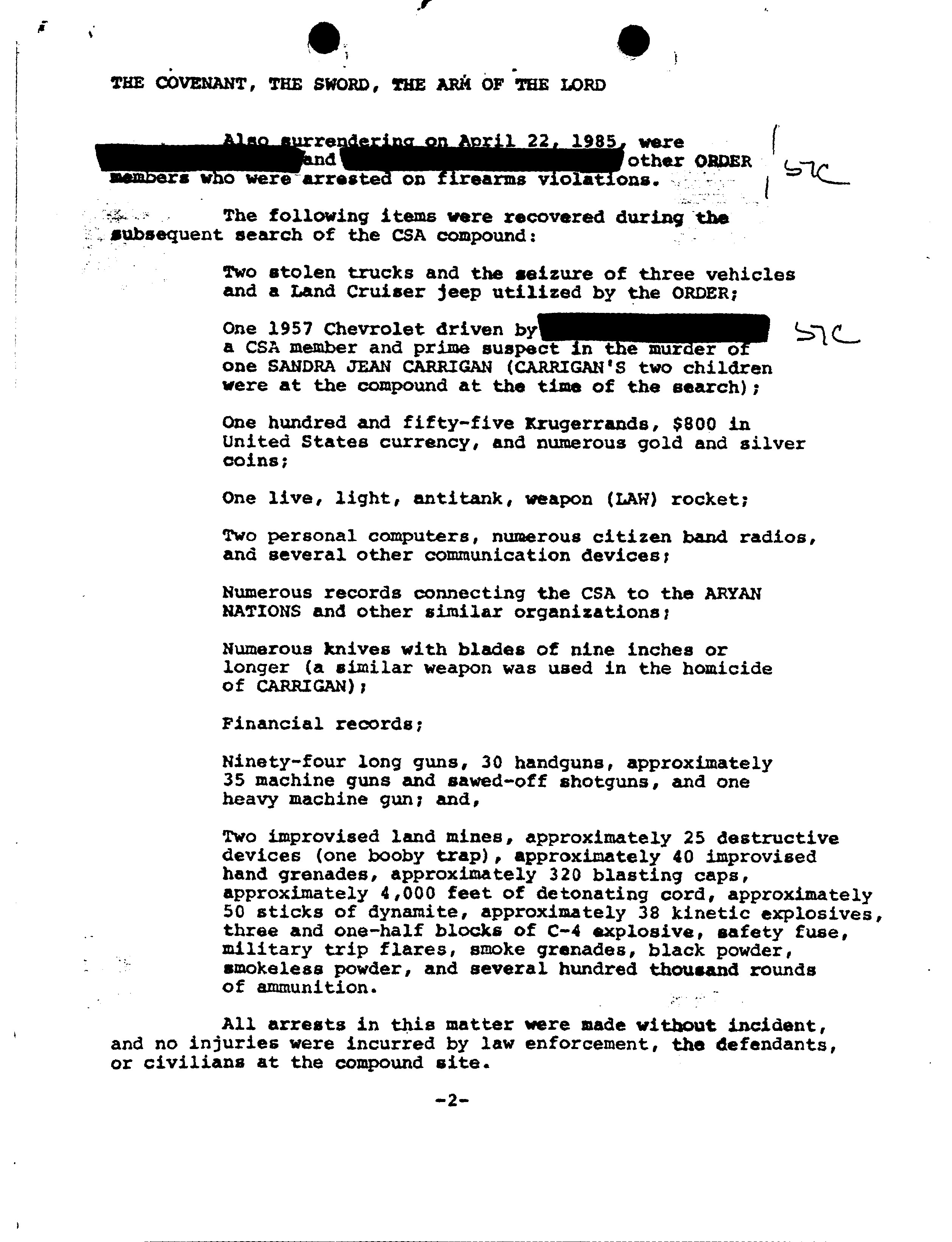
The difference between a peaceful ending and a harmless organization is equally important. The search uncovered weapons and other evidence, and prosecutions followed. A nonviolent arrest does not erase earlier victims or imply that the threat had been imaginary. It means that this phase ended without the additional deaths that an armed confrontation could have caused. The May memorandum explicitly reports no injuries among law-enforcement personnel, defendants, or civilians at the site. That is an agency report of the outcome, not a claim that the entire history had been bloodless.

The operation later became a point of comparison in the Justice Department’s review of Waco. The review describes a containment-and-negotiation approach in the CSA case while emphasizing different circumstances at Waco. Such comparisons can clarify the choices officials remembered, but cannot establish that one method guarantees the same result in every crisis. Here the documented result is enough to matter: people who expected a final confrontation were instead taken into custody, and the question of criminal responsibility moved from the perimeter of the compound to the courts.

Sources: S01 · S02 · S04 · S05 · S06 · S13 · S14 · S17

FBI inventory and report of no injuries, 20 May 1985
The second page of the May 1985 memorandum inventories recovered material and states that no one was injured at the compound. An inventory records a seizure; it is not a verdict on every resident. Image credit ↗

Chapter 05 / 1985–1988

One movement. Different verdicts.

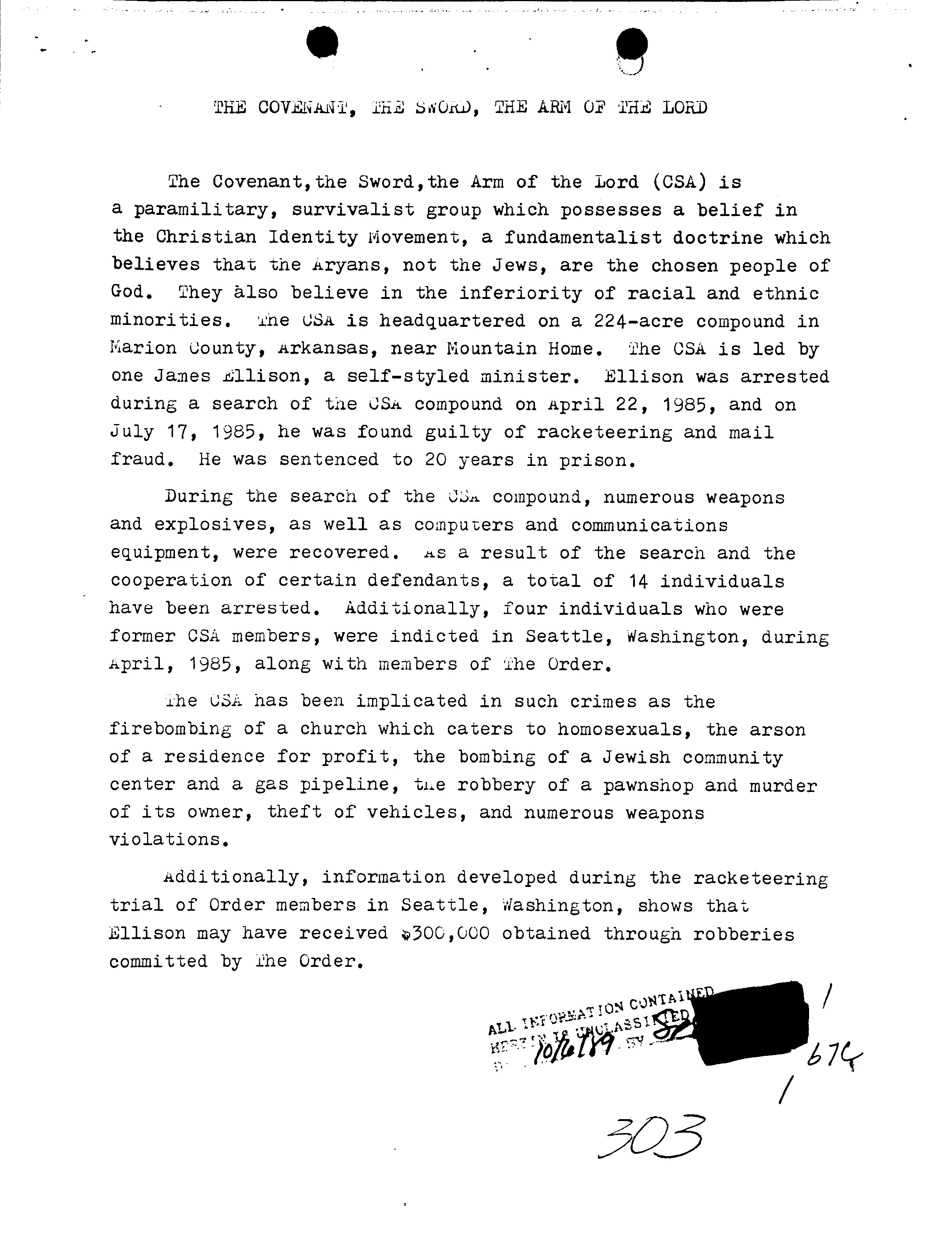
Ellison’s prosecution provides an essential correction to a story that ends with his surrender. The Eighth Circuit’s 1986 opinion identifies a racketeering conviction and a conviction involving interstate travel to promote arson. It separately describes conditional guilty pleas on firearms-related charges. Those distinctions matter: an arrest, a jury conviction, and a guilty plea are different procedural events, even when they concern the same defendant. The appellate court affirmed the challenged judgments rather than treating the compound’s religious character as a bar to criminal accountability.

Ellison attacked the search on constitutional grounds, including the reliability of informants and the specificity of the warrant. The court considered those arguments and upheld the search. It acknowledged that investigators should, as good practice, have disclosed that some informants had been incarcerated or had received financial consideration. But it concluded that the omissions did not defeat probable cause in this case. An accurate history can recognize that criticism and the court’s ultimate holding together. Neither the government’s allegations nor the defendant’s objections should be substituted for the decision.

The later Fort Smith sedition trial was a different case. In 1988, prosecutors sought to prove a much broader conspiracy involving figures from the racist right. Ellison appeared as a government witness. The trial ended without guilty verdicts against the remaining thirteen defendants. The result must remain part of the story, even if the ideology and some separate criminal conduct are well documented. An indictment is a proposal to prove charges, not proof that the jury accepted them.

These outcomes do not cancel one another. The failure of the broad sedition prosecution did not vacate Ellison’s earlier convictions or Snell’s murder conviction. Conversely, those convictions did not establish the later conspiracy charges against everyone on trial. This is where a documentary guide has to resist the attraction of one comprehensive verdict on an entire milieu. The historical connections may be real while the legal outcomes remain defendant-specific and charge-specific. The distinction is not a technical footnote; it is part of what happened.

Sources: S01 · S02 · S03 · S08 · S14 · S16

FBI summary of the investigation and prosecution
A later FBI summary combines the group’s ideology, recovered evidence, convictions, and other suspected crimes. Its different evidentiary categories should be read separately. Image credit ↗

Chapter 06 / 1988–2026

What the surviving record can tell us

After the compound’s confrontation with the authorities, the CSA’s history survived in several different forms. Federal files preserved an investigative view. Court opinions preserved the disputes selected for appeal. Television and radio preserved interviews and images. Former members carried memories of communal life, radicalization, and imprisonment. None is a complete substitute for the others. A record of a seizure can be precise about an object and silent about a resident’s experience; a recollection can be vivid about experience and uncertain about dates.

Noble later became one of the principal interpreters of that inside experience. His memoir, Tabernacle of Hate, and a 2020 publisher interview describe both his participation and his rejection of the movement’s racism. They give readers a way to examine how belonging, fear, and authority operated within the community. They also raise an ordinary question of source criticism: a former participant is explaining a past he helped create. His account deserves attention without becoming the sole authority on everyone else’s conduct or on every abandoned plan.

Later documentaries place the group within a larger history of the American racist right. That broader frame can explain relationships and the circulation of ideas. It can also tempt viewers to connect later events more directly than the evidence permits. A shared milieu, an overlapping contact, or a familiar date is not by itself proof of an operational chain. This guide does not turn the CSA into a hidden author of every later act of antigovernment violence, nor infer a direct organizational connection merely because the John Birch Society has a separate guide in this series.

The durable findings are substantial without that enlargement. A religious community adopted a racial and paramilitary program; criminal acts and individual victims belong to its history; a dangerous confrontation ended in negotiated surrender; and the courts reached different outcomes in different prosecutions. The remaining questions concern degree, chronology, and specific responsibility. Returning to the documents does not drain the story of force. It restores the distinction between a memorable name and an explanation that the surviving evidence can actually sustain.

Sources: S01 · S08 · S09 · S10 · S11 · S12 · S15 · S18

03 / The record

People, not a single cast of mind

Open a record for the person’s role and supporting sources. Portraits appear only where a verified public-domain photograph is included.

EllisonBiographical record
James D. EllisonFounder, leader, convicted defendant

Led the community and CSA. The 1986 appellate opinion identifies the convictions and conditional pleas separately; he later testified for the government in the 1988 sedition case.

Sources: S02 · S08

NobleBiographical record
Kerry NobleCommunity leader, later memoirist

A religious teacher and public spokesman who later described his radicalization, role in the surrender, imprisonment, and rejection of racism. His retrospective account is identified as participant testimony.

Sources: S10 · S11

SnellBiographical record
Richard Wayne SnellConvicted murderer; CSA-connected actor

The Stumpp murder appeal documents his conduct and ties to people at the compound. Formal membership and demonstrated involvement are distinct questions; neither establishes identical guilt for every resident.

Sources: S03

StumppBiographical record
William StumppVictim · Texarkana pawnshop owner

Killed on 3 November 1983. The 1986 Arkansas Supreme Court opinion is the principal source here for the murder, its date, the trial, and the appeal.

Sources: S03

BryantBiographical record
Louis Perry BryantVictim · Arkansas State Police trooper

Killed in June 1984. The July 1984 FBI update and the Snell opinion identify him as an Arkansas officer. Do not confuse his case with a different Missouri trooper investigation.

Sources: S01 · S03

PurtleBiographical record
John I. PurtleArkansas Supreme Court justice; dissenter

Dissented in the 1986 Stumpp appeal, criticizing the trial’s atmosphere and use of broad CSA evidence. His dissent is part of the record; the majority’s affirmance remained the judgment.

Sources: S03

04 / The record

A chronology of conflict

Horizontal spacing shows elapsed time; separate rows keep close events selectable. Scroll the graph on narrow screens. Exact dates are attributed where records conflict; month- and year-only dates preserve source precision.

19711985199920132026
The early community takes shapeOrigins

Early-1970s origin. Regional histories give 1971; the July 1982 FBI summary says 1970. The public CSA name came later, according to Noble.

Sources: S01 · S07 · S11

The Arkansas settlementOrigins

Mid-1970s move to the property near the Missouri border. The July 1982 summary dates the purchase to 1976.

Sources: S01 · S02

Noble joins the communityBelief

Date supplied by Noble in his 2020 retrospective interview, not an independently audited membership roll.

Sources: S11

Preparation takes a paramilitary turnBelief

The appellate court dates a reorientation toward government collapse and civil war to 1978.

Sources: S02

The CSA name becomes publicOrganization

Noble’s later account dates public use of the paramilitary name to 1981. This is distinct from the religious community’s origin.

Sources: S11

The FBI records a community estimateRecord

Ninety to 120 men, women, and children in the July 1982 summary. Do not re-label this estimate as armed adult membership.

Sources: S01

The federal investigation developsInvestigation

The Eighth Circuit dates the active investigation to 1983 and intensified interviews with former residents to 1984.

Sources: S02

William Stumpp is killedViolence

The pawnshop murder date in the Arkansas Supreme Court opinion. Some later summaries misdate the event.

Sources: S03

Trooper Louis Bryant is killedViolence

Arkansas State Police officer. The July FBI update and the court record identify the case; month-level precision used here.

Sources: S01 · S03

The FBI issues a new community updateRecord

The report describes a smaller population and identifies the Bryant killing. Figures remain attributed investigative estimates.

Sources: S01

Search warrant obtained, per FBI memoInvestigation

The May 20 memorandum in Part 01, PDF p. 17, supplies this date. The appellate opinion later upholds the warrant and search.

Sources: S01 · S02

Negotiation begins, per FBI memoSiege

PDF p. 17 dates the surrounding of the compound to April 20. Other records and recollections date the beginning differently; do not treat this point as a resolved universal chronology.

Sources: S01 · S06 · S11

Surrender, per May FBI memoSiege

The May report dates surrender to April 22. An October form lists an April 21 arrest; contemporary reporting and later summaries vary. The peaceful outcome is much more consistent than the exact dates.

Sources: S01 · S02 · S06 · S17

A memo records recovered materialRecord

The two-page summary includes the seizure inventory and reports no injuries at the compound. It is included locally in the original redacted release.

Sources: S01

Ellison’s appeal is decidedCourts

The Eighth Circuit affirms the challenged judgments and rejects the search-warrant arguments.

Sources: S02

The Stumpp murder appeal is decidedCourts

The Arkansas Supreme Court affirms Snell’s conviction; Justice Purtle dissents.

Sources: S03

The Fort Smith sedition case ends in acquittalsCourts

The remaining thirteen defendants are acquitted. These verdicts concern the later broad prosecution, not every earlier case involving the milieu.

Sources: S08 · S16

Noble’s memoir is first publishedMemory

The publisher identifies 1998 as the first edition of Tabernacle of Hate. Later editions and interviews revisit the inside account.

Sources: S10

Regional radio revisits the CSAMemory

KUAF reporting combines federal files and interviews.

Sources: S09

Noble gives a retrospective interviewMemory

An attributed account of the community’s changes, the surrender, and departure from racism.

Sources: S11

The sedition trial returns through broadcast archivesMemory

KUAF and the Pryor Center revisit the trial’s regional record.

Sources: S15

05 / The record

The load-bearing facts

Six steps that any serious interpretation has to handle. Open each step for its dependencies, why it matters, and the questions it leaves for rival accounts.

P1

Separate the community from the later public name

A religious refuge, an Arkansas settlement, and a publicly named paramilitary unit are different moments.

Why it is critical

Collapsing them into one founding date conceals the process the guide is trying to explain.

Dependencies

Starting chronology. The 1970/1971 source conflict remains visible.

What rival readings must explain

Both the radicalization and the criminal-enterprise readings must account for change over time.

Sources: S01 · S02 · S11

P2

Identify the racial program and organized activity

The records describe Christian Identity, white supremacy, and paramilitary preparation.

Why it is critical

Without these specifics, the story becomes an account of generic rural religiosity or ordinary emergency preparation.

Dependencies

Depends on P1: identify which stage of the community is being described.

What rival readings must explain

A religious-liberty account must address the actual program; a critical account must avoid generalizing it to all Christians or survivalists.

Sources: S01 · S02

P3

Attach criminal responsibility to evidence and people

The Snell and Ellison cases concern particular acts, defendants, and legal findings.

Why it is critical

Without this link, an organizational label substitutes for proof and the victims disappear into a list of alleged movement crimes.

Dependencies

Depends on P2 for context, but ideology does not itself prove an offense.

What rival readings must explain

Every interpretation must handle both the convictions and the objections recorded in the opinions.

Sources: S02 · S03

P4

Explain the negotiated surrender

The April 1985 operation ends without reported injuries at the compound.

Why it is critical

Omitting negotiation turns a distinctive event into a generic armed raid; omitting earlier crimes makes a peaceful ending look like evidence of innocence.

Dependencies

Depends on P3 and the warrants that brought authorities to the site.

What rival readings must explain

The government-success account must acknowledge source discrepancies; the siege narrative must explain the recorded nonviolent outcome.

Sources: S01 · S02 · S06 · S13

P5

Keep the later acquittals distinct

The 1988 sedition prosecution fails to produce convictions against the remaining defendants.

Why it is critical

Without the verdicts the guide repeats an indictment as fact. Without earlier cases it wrongly turns acquittal into a universal exoneration.

Dependencies

Depends on P3 and P4: different cases follow the dismantling of the compound.

What rival readings must explain

Both the criminal-network and overbroad-prosecution accounts must preserve the defendant-specific outcomes.

Sources: S02 · S03 · S08 · S16

P6

Test the afterlife without inventing a command chain

Memoir, archives, and documentaries explain how the CSA is remembered; resemblance does not establish later operational control.

Why it is critical

Without a transmission standard, every later incident can be absorbed into an unfalsifiable story.

Dependencies

Depends on P1–P5 and on the difference between participant testimony and independent corroboration.

What rival readings must explain

Any legacy claim must identify people, documents, or institutions that connect the proposed events.

Sources: S09 · S10 · S11 · S12 · S18

06 / The record

Four ways to read the record

Competing interpretations, stated at their strongest and tested against the same chain. Presenting a theory is not endorsing it.

Interpretation 01

A community radicalized over time

Supported sequence; motives vary by participant

The strongest version

The move from retreat to racial theology and armed organization developed through leadership choices, outside contacts, and a widening sense of threat.

Accepts

P1–P2 and the later criminal record in P3.

Must still explain

Must avoid making one former leader’s memory the experience of every resident, or treating the original community as if its later trajectory was inevitable.

Assessment

The appellate chronology and early FBI summaries support change over time. Noble’s account provides an attributed inside explanation.

Sources: S01 · S02 · S11

Interpretation 02

A criminal enterprise behind a religious refuge

Strongly supported for the prosecuted conduct

The strongest version

The organization’s infrastructure and relationships enabled crimes beyond the compound; religious and survivalist language did not make those acts lawful.

Accepts

P2–P4, including Ellison’s RICO conviction and the individual murder case.

Must still explain

Must distinguish proven conduct from investigative allegations and preserve the 1988 acquittals in P5.

Assessment

The opinions supply the strongest legal basis. Neither a broad label nor a guilty verdict in one case settles every other allegation.

Sources: S02 · S03 · S08

Interpretation 03

A successful negotiation under dangerous conditions

The outcome is supported; universal tactical lessons are limited

The strongest version

Containment and dialogue secured surrender and evidence without additional deaths at the compound.

Accepts

P4 and the prosecutions that followed.

Must still explain

Must not erase earlier victims, ignore multiple agencies, or claim that a different crisis would necessarily end the same way.

Assessment

The contemporaneous memorandum, appellate narrative, reporting, and later DOJ comparison converge on a negotiated ending.

Sources: S01 · S02 · S06 · S13 · S14

Interpretation 04

The broad conspiracy case outran what prosecutors proved

Acquittals established; wider historical meaning remains debatable

The strongest version

Relationships among extremist figures did not persuade the 1988 jury to convict the remaining defendants on the government’s charges.

Accepts

P5 and the distinction between association and a legally proved agreement.

Must still explain

Must not convert that result into a claim that Ellison’s earlier convictions, Snell’s murders, or the recovered evidence never existed.

Assessment

The verdicts limit what can be asserted as legally established in that case. They do not rewrite every other prosecution.

Sources: S02 · S03 · S08 · S16

07 / The record

How the story changed

Public memory tends to compress contested histories into a turning point. The records leave a less tidy sequence.

Early community → paramilitary identity

ThenA religious refuge and a later named organization can collapse into a single origin story.

ReconsideredThe early FBI report, appellate chronology, and Noble’s recollection preserve different stages. Even the name’s adoption needs a source and date.

Sources: S01 · S02 · S11

April 1985 → a legend of a raid

ThenThe visual shorthand is an armed camp surrounded by federal agents.

ReconsideredThe record gives negotiation and surrender a central role. Exact dates differ, but a deadly final firefight is not what the sources describe.

Sources: S01 · S02 · S06 · S13

Convictions → the 1988 trial

ThenA web of associations made a broad conspiracy allegation plausible to prosecutors.

ReconsideredThe 1988 jury did not convict the remaining defendants. That outcome must coexist with earlier, separate convictions.

Sources: S02 · S03 · S08 · S16

Participant → critic of his own past

ThenNoble helped explain and promote the community’s worldview.

ReconsideredHis memoir and later interview repudiate its racism and describe his exit. These sources expand the inside record while retaining the limits of retrospective testimony.

Sources: S10 · S11

08 / The record

What the evidence supports

Ratings apply to the precise proposition on the page. Unsupported means the assembled evidence does not establish a claim; it is not interchangeable with false.

Established

The CSA advocated white supremacy and Christian Identity.

The FBI records, the appellate opinion, and Noble’s account identify the racial program. This is a specific ideology, not a label for Christianity generally.

Sources: S01 · S02 · S11

Misleading

The organization existed under exactly the same name from its first day.

The early religious community, Arkansas property, and public paramilitary name are separate stages. Noble dates public CSA naming to 1981.

Sources: S01 · S02 · S11

False

Every resident was an armed adult militia member.

The July 1982 population estimate explicitly includes men, women, and children. It cannot be used as a combatant census.

Sources: S01

Established

William Stumpp was murdered in 1983.

The Arkansas Supreme Court identifies the date as November 3, 1983. A differing date in a later summary does not supersede the case record.

Sources: S03 · S07

False

Louis Bryant was a Missouri state trooper.

The July 1984 FBI update and the Snell opinion identify an Arkansas State Police officer. A later agency summary appears to conflate regional cases.

Sources: S01 · S03 · S05

False

The compound’s final surrender involved a deadly firefight.

The May 1985 FBI memorandum reports no injuries at the site, and the appellate account describes surrender after negotiation. Earlier deaths remain a separate part of the history.

Sources: S01 · S02 · S06

False

Every source gives identical dates for the siege.

The May memorandum, the October arrest form, contemporary reports, and participant recollections do not fully agree. The guide attributes exact dates rather than silently choosing one.

Sources: S01 · S06 · S11 · S17

Established

Ellison was convicted, not merely accused.

The 1986 appellate opinion identifies RICO and arson-related convictions, separately describes conditional firearms pleas, and affirms the challenged judgments.

Sources: S02

False

The 1988 sedition indictment resulted in convictions.

The remaining thirteen defendants were acquitted. The government’s accusation is not the verdict.

Sources: S08 · S16

False

The 1988 acquittals erased all earlier CSA-related convictions.

Those outcomes concern a separate prosecution; they did not vacate Ellison’s earlier judgments or Snell’s murder conviction.

Sources: S02 · S03 · S08

Established

Noble later publicly rejected the movement’s racism.

His publisher interview and memoir record a public repudiation. This establishes his stated later position, not independent corroboration of every retrospective account.

Sources: S10 · S11

Unsupported

A shared extremist milieu proves CSA directed later attacks.

Connections can be historically significant without proving a specific operational agreement. A legacy argument must identify an evidentiary chain.

Sources: S08 · S12 · S18

09 / The record

Hear the argument

Recorded voices, reported history, and documentary context. External media need an internet connection.

KUAF · reported audio · 2015

The CSA through files and interviews ↗

Jacqueline Froelich revisits the compound through federal records and interviews. Includes archival photographs with individual credits; the linked recording requires internet access.

PBS American Experience · film and transcript

Kerry Noble in the wider history ↗

Oklahoma City includes Noble’s participant testimony in a larger documentary. Read its broader connections as historical framing, not an automatic chain of CSA command.

KUAF / Pryor Center · archive discussion · 2024

The Fort Smith trial, remembered ↗

A regional broadcast-archive discussion returns to the 1988 trial and its outcome. The archive finding aid separately identifies original April 1985 footage.

10 / The record

The questions still open

A documented limit is more useful than a confident number or a sweeping lineage the evidence cannot carry.

  1. Which reported acts can be assigned to particular participants beyond the cases and appellate records examined here?
  2. Can operational logs and the underlying arrest papers reconcile April 19–22 siege chronologies more precisely than later summaries do?
  3. How did women, children, and less visible residents experience the community and its dissolution? Leadership testimony is not a complete social history.
  4. Which later networks can be traced through documents and people, rather than inferred from similar rhetoric or shared anniversaries?

11 / The record

Go back to the sources

Records, reporting, and firsthand accounts have different evidentiary roles. Each source note explains what it can establish and where caution is needed. Sources consulted for this edition on 25 October 2026; publisher restrictions may apply.

  1. S01

    Contemporaneous federal records

    The CSA file, Part 01 — 70-page redacted release ↗

    Federal Bureau of Investigation

    Original PDF included locally under records/fbi-part-01.pdf. Key PDF pages: 2–3 (July 1982); 9 (July 1984); 17–18 (May 1985); 58 (October 1985 arrest-date entry); 68 (later prosecution summary). Reports preserve redactions and may contain unproven allegations or conflicting dates.

  2. S02

    Primary appellate opinion

    United States v. James D. Ellison, 793 F.2d 942 (1986) ↗

    U.S. Court of Appeals for the Eighth Circuit / Justia

    Decided 17 June 1986. Opening paragraphs distinguish the RICO/arson convictions from conditional firearms pleas. The opinion also addresses the search warrant, informants, and enterprise evidence; its description of the record should not be flattened into a verdict on every member.

  3. S03

    Primary appellate opinion

    Snell v. State, 721 S.W.2d 628 (1986) ↗

    Arkansas Supreme Court / Justia

    Decided 15 December 1986. The Stumpp murder case documents individual responsibility and connections with CSA associates. The majority affirms; the dissent objects to the breadth and prejudice of CSA evidence. Both are part of the decision.

  4. S04

    Institutional retrospective

    FBI Little Rock field-office history ↗

    Federal Bureau of Investigation

    Confirms the 1985 surround-and-surrender operation and multiple agencies. An agency history is not an independent evaluation of its own performance.

  5. S05

    Institutional retrospective

    FBI Kansas City field-office history ↗

    Federal Bureau of Investigation

    Describes negotiation and recovered weapons. Its reference to a killed Missouri trooper should not be used to relabel Arkansas Trooper Louis Bryant: regional cases and agencies must be distinguished.

  6. S06

    Contemporaneous reporting

    CSA operation sends new signal to extremists groups, 28 April 1985 ↗

    United Press International

    A contemporary account emphasizing negotiation and the intention to arrest Ellison and search the camp. Reports a four-day standoff; the exact date/duration is not identical across records.

  7. S07

    Regional historical reference

    Covenant, the Sword and the Arm of the Lord ↗

    Encyclopedia of Arkansas

    Useful regional synthesis. Some dates diverge from the primary record, including its pawnshop-murder date: the 1986 Snell opinion places Stumpp’s murder on 3 November 1983. This guide follows the court for that event.

  8. S08

    Regional trial history

    Fort Smith Sedition Trial of 1988 ↗

    Encyclopedia of Arkansas

    Describes the government’s broad theory, witness disputes, and the failure to obtain guilty verdicts. Read alongside contemporaneous acquittal reporting; do not confuse this case with Ellison’s earlier convictions.

  9. S09

    Reported history / recorded interviews

    The Covenant, Sword, and Arm of the Lord, 18 March 2015 ↗

    Jacqueline Froelich / KUAF Ozarks at Large

    Recorded reporting drawing on redacted FBI files and interviews. Its contemporary and retrospective voices are evidence with different dates and perspectives. Images on the page have their own credits; they are not assumed freely reusable.

  10. S10

    Participant memoir / publisher record

    Tabernacle of Hate, second edition ↗

    Kerry Noble / Syracuse University Press

    Publisher’s description and contents, not a full-text audit of the memoir. Identifies Noble’s account of radicalization, the attempted church attack he abandoned, and later departure from extremism.

  11. S11

    Primary retrospective interview

    Interview with Tabernacle of Hate author Kerry Noble, 23 September 2020 ↗

    Syracuse University Press

    Noble dates his arrival to 1977, describes ideological changes, and dates public adoption of the CSA name to 1981. His account is attributed testimony, not an independently verified census or proof of every alleged plot.

  12. S12

    Documentary / recorded participant testimony

    Oklahoma City — film and transcript ↗

    PBS American Experience

    Includes testimony from Noble within a broader history of the radical right. It is an external video/transcript resource, not footage proving a formal CSA chain of command over the 1995 bombing.

  13. S13

    Official review, 1993

    Report to the Deputy Attorney General on the Events at Waco, Texas ↗

    U.S. Department of Justice / OJP archive

    Printed p. 119, PDF p. 131, compares the CSA operation’s containment and negotiation with Waco. The contexts differ; the comparison is not a controlled test of tactics.

  14. S14

    Official record / prosecutor’s retrospective account

    Senate judicial-confirmation record — Ellison prosecution summary ↗

    U.S. Senate / Government Publishing Office

    Printed p. 25 summarizes United States v. Ellison, its racketeering prosecution, and a prosecutor’s role in negotiating surrender. This is an identified participant’s later professional account.

  15. S15

    Archival broadcast discussion

    Recalling the Fort Smith sedition trial of 1988, 9 April 2024 ↗

    KUAF / David and Barbara Pryor Center

    Audio discussion using regional broadcast archives; separates recollection of the trial from a claim that the indictment itself proved guilt.

  16. S16

    Contemporaneous verdict reporting

    13 White Supremacists Acquitted in Arkansas Murder and Sedition Trial, 8 April 1988 ↗

    The Washington Post

    Contemporary corroboration of the acquittals. Publisher access may be restricted; the regional historical account supplies an accessible discussion.

  17. S17

    Contemporaneous reporting

    5 White Supremacists Give Up After 4-Day Siege in Arkansas, 22 April 1985 ↗

    Los Angeles Times / Times Wire Services

    Contemporary headline and date illustrate the April 1985 press chronology. Publisher access may be restricted. Consult the original FBI memorandum and the caveat about exact dates.

  18. S18

    Primary audiovisual archive finding aid

    Master Control Room collection inventory ↗

    David and Barbara Pryor Center / University of Arkansas

    Inventory p. 131 lists April 1985 CSA interviews, stakeout footage, field tapes, and arrests. A finding aid establishes holdings, not open streaming access or the accuracy of every tape label.

Open the original FBI release — local PDF ↗

Images, documents & licensing

FBI summary of the CSA community, 2 July 1982 — Federal Bureau of Investigation / FBI Vault, Part 01. Public domain — original U.S. federal government document. Source & license ↗. Resized and re-encoded for this edition; embedded metadata removed.

FBI account of CSA beliefs and training, July 1982 — Federal Bureau of Investigation / FBI Vault, Part 01. Public domain — original U.S. federal government document. Source & license ↗. Resized and re-encoded for this edition; embedded metadata removed.

FBI update on membership and the Bryant killing, 17 July 1984 — Federal Bureau of Investigation / FBI Vault, Part 01. Public domain — original U.S. federal government document. Source & license ↗. Resized and re-encoded for this edition; embedded metadata removed.

FBI memorandum on the surrender, 20 May 1985 — Federal Bureau of Investigation / FBI Vault, Part 01. Public domain — original U.S. federal government document. Source & license ↗. Resized and re-encoded for this edition; embedded metadata removed.

FBI inventory and report of no injuries, 20 May 1985 — Federal Bureau of Investigation / FBI Vault, Part 01. Public domain — original U.S. federal government document. Source & license ↗. Resized and re-encoded for this edition; embedded metadata removed.

FBI summary of the investigation and prosecution — Federal Bureau of Investigation / FBI Vault, Part 01. Public domain — original U.S. federal government document. Source & license ↗. Resized and re-encoded for this edition; embedded metadata removed.

Typefaces: Newsreader and IBM Plex Sans, distributed locally under the SIL Open Font License. License texts are included in the fonts folder. No AI-generated portraits are used.